
Student leadership at Mount Carmel has always meant responsibility, but there will be a change in the structure of student leadership and an entire system being rebuilt from the ground up for the 2026-2027 school year.
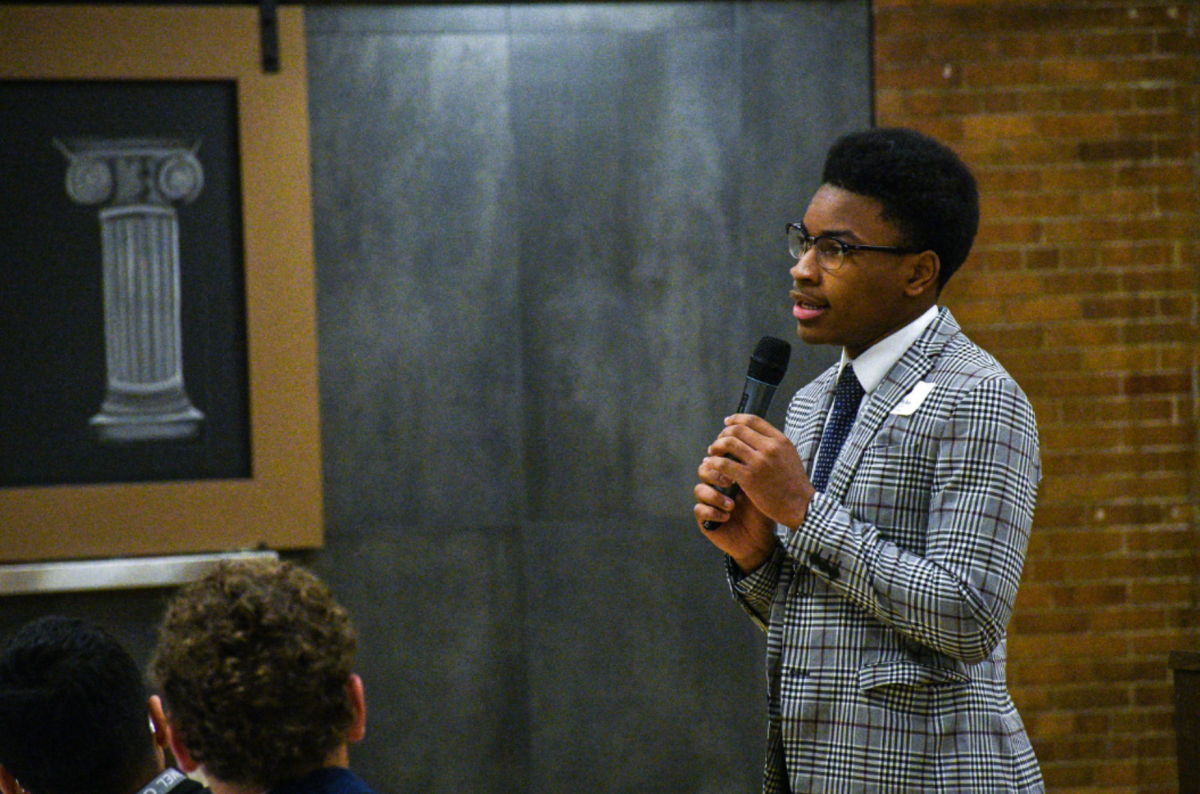
Recently, junior Aaron Hyler was announced as Student Body President for the next school year. Unlike previous years, the student body voted for the president. This presidency is tied directly to a new student government model connected to the House system at MC. Because of that, Hyler is not just leading students in a traditional sense but also helping guide how this new system will actually function in real time. This makes his role more complex than that of past student presidents, since expectations are still forming as the structure develops.
When Hyler learned he had been selected as Student Body President, his reaction focused more on responsibility than celebration. He immediately shifted toward thinking about what needed to be done rather than the title itself.
“I was excited,” he says. “I was more ready to work than I was excited.”
That mindset was also noticed by administrators who watched him throughout the selection process. Principal Scott Tabernacki described Hyler as someone who others can look up to.
“I think if you’ve ever met Aaron, anybody, adult or peer, they would say to him he’s mature well beyond his years,” Principal Tabernacki says.
Hyler’s ideas and what he does with them also set him apart from other candidates.
“I don’t think he just talks a big game,” says Mr. Tabernacki. “I think he delivers.”
His significant involvement across academics, activities, and student events has made him a familiar presence throughout the building.
“From the way he interacts with freshmen, to the way he interacts with his classmates as an adult, I see that all the time,” Mr. Tabernacki says when talking about seeing Hyler act as a leader.
One specific moment that stood out to him was during Mother’s Day Mass earlier this month.
“We all saw it in the last Mother’s Day Mass with Mrs. Norise,” Mr. Tabernacki said regarding a tribute to retiring chemistry teacher Emma Norise. “That was all him-driven, listening and helping some others, but when he was speaking, and he was able to pull that off, I thought in my head, ‘Okay, that’s what we’re looking for.”
Because of that consistency, staff members noted that Hyler is already heavily involved in multiple areas of school life. That involvement helped strengthen his overall leadership profile during the election process.
“He really is involved in many of the things that the school cares about,” Mr. Tabernacki says. Hyler’s extracurriculars include National Honor Society, Caravan Media Group, Medical Enrichment Club, Law Club, Peer Leaders, T.H.E Club (Together Helping Each Other), Jazz Band, Chess, Drama, 64th Chapter, Multicultural Club, and morning announcer.
MC is currently transitioning into a new house-based student government system designed to increase representation. This change shifts leadership away from a traditional model and into a more structured system with student participation at multiple levels. English teacher Mr. Daniel Haggerty, who is helping design the system, explained that the focus is to make the student government more representative and more active in school life.
“Our hope is that the student government structure that we create is more of a true representative government that gives every student the ability to have a voice and get involved,” Mr. Haggerty says.
This system also means that Hyler’s role will connect directly with 24 student representatives, one elected by each Studium rather than just a small council, and also 4 speakers of the house, one from each floor. The system is designed so that student representatives who are elected will bring a wider variety of student ideas, concerns, and feedback to House Council meetings. Those representatives will then return to their Studium to communicate what was discussed, creating a consistent flow of information between students and leadership. This structure is intended to make student participation more active and ensure that more voices are included in decisions throughout the school year.
Mr. Haggerty believes this change will increase student influence in decision-making compared to previous years. He sees it as a step toward stronger student engagement overall.
“We really think that this new structure will actually give students more power and more influence and more ability to express their ideas,” he says.
Students have also started reacting to Hyler’s leadership in different ways. MC junior Isaiah Rauch has a strong positive reaction to his selection.
“I was so happy because I know the student body’s in good hands,” Rauch said.
Other students are more focused on action and results rather than reputation or expectations. Junior Gavin Williams explained that effort matters more than perfection.
“I just want him to try things,” he said. “I don’t care if they work or if they don’t.”
As Hyler prepares for his term, he has already started outlining priorities focused on organization and structure. One of his main goals is to improve how student events are coordinated throughout the year.
“Main goal is to be organized,” he said.
Hyler also believes that school spirit is an area that needs improvement. He feels that student engagement could be stronger across the school community.
“I think school spirit is also a big one,” Hyler said. “There is not much school pride.”
His plans for how to boost school spirit include ideas like tailgating, having student section leaders, a daily countdown post for an upcoming game, and student section challenges.
As MC moves into a new system of student government, Hyler’s presidency sits at the center of change and expectation. He is stepping into a leadership role that is still developing while also being expected to help shape it.
Those around him describe him as prepared, involved, and capable of handling responsibility in a shifting system. His success will depend on how well he turns ideas into action as the year unfolds.
For now, his presidency begins not with a finished system, but with one still being built around him.