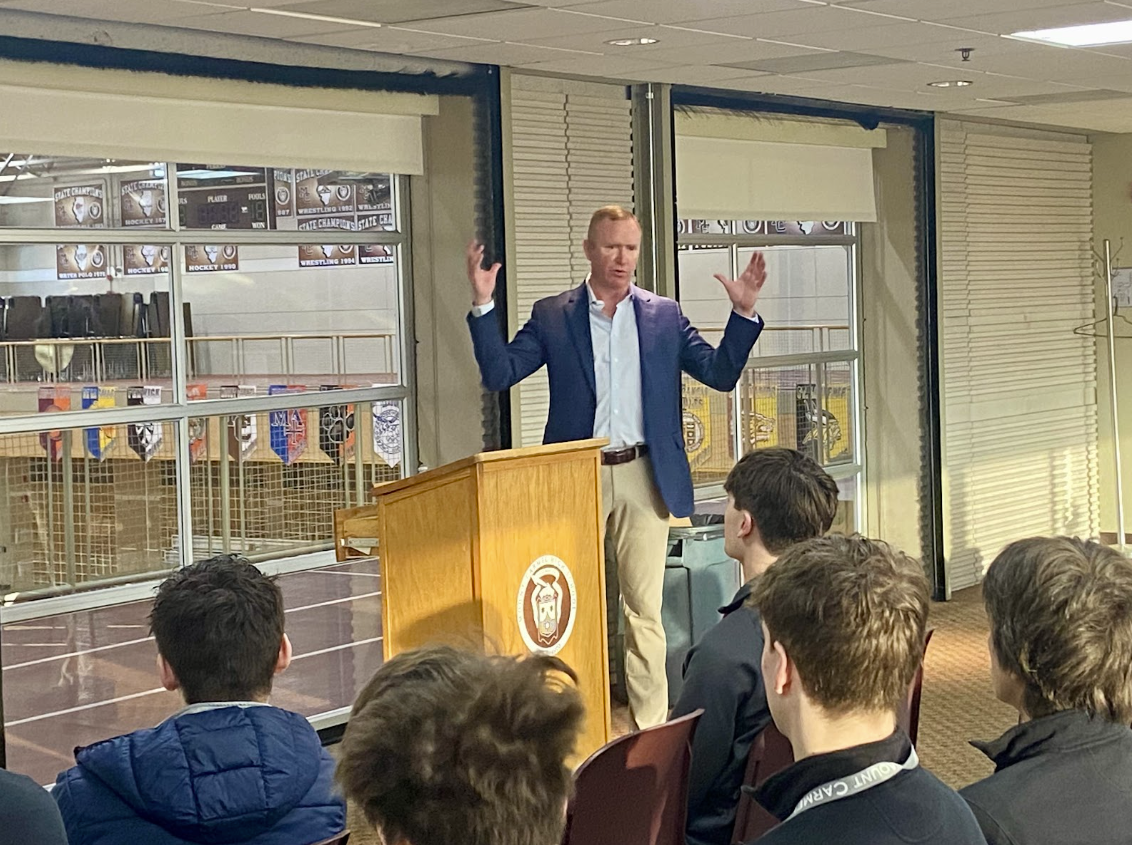

When Mr. Casey Toner graduated from Mount Carmel in 2001, he did not know he would one day spend his career investigating governments and holding powerful institutions accountable through journalism.
Mr. Toner is now an investigative journalist based in Chicago who has spent more than a decade reporting on crime, public records, and government accountability, including investigations published by the Better Government Association. Early in his career, his work consisted of breaking news coverage, but his current work involves long-term investigations.
Mr. Toner spends most days researching documents, making phone calls, and requesting records that slowly piece together a larger story. Writing comes only after the reporting is complete, not before.
“I’m at the point in my career where I’m doing these kinds of longer stories that take a minute to cook,” he says. “I’m reading a lot of papers, calling people on the phone, sending out requests for records, getting those records back, and then eventually I’ll write a story.”
He compared the job to a research assignment, where writing comes after a strong understanding of the topic. Without that preparation, he thinks the final story would fall apart.
“In order to write, you have to do all these other things first,” he says. “That’s kind of what my job is.”
Early in his career, Mr. Toner’s work looked very different. He spent years covering breaking news on Chicago’s South Side and in the south suburbs, where every day was different. Stories often happened fast, and he needed to act quickly.
“If anything bad or crazy happened, I’d just be there with my notebook talking to people,” he says.
The unpredictable nature of breaking news made it difficult to have a schedule. He admitted that chaos frequently disrupted his personal life.
“My plans would often get screwed up,” he says. “I was always late for everything.”
As Mr. Toner moved into investigative journalism, his work shifted toward uncovering larger problems. One of his major investigations unveiled Chicago gun buy-back programs, which required a lot of research.
“Using this data, I was able to identify the gun itself that got stolen,” he says.
He explained that stories like this can be uncomfortable for those in power, but that discomfort is part of journalism’s purpose.
“There’s a genuine thrill in knowing that this is going to make somebody very mad,” he said. “But ultimately this will show people how things work.”
Although Mr. Toner did not write for the student newspaper while attending MC, he believes the school influenced his decision. He pointed to the school’s student body as an important factor.
“Mount Carmel is very diverse,” he says. “I got a good experience of getting to know people from many different backgrounds.”
Toner also explained that attending MC expanded his understanding of Chicago beyond his own neighborhood.
“Geographically, having gone to Mount Carmel, I’ve seen more of the city than a lot of people,” he says.
After graduating from MC, Mr. Toner went to Northern Illinois University, where he got a Bachelor of Arts in journalism. He was interested in journalism, but he said it was not until college that he started taking it seriously and would soon discover that journalism was something he was naturally good at and genuinely enjoyed.
“My sophomore year, I began working at the college newspaper,” he says. “ Then it was almost automatic, I was like, oh, this is what I want to do.”
After college, Mr. Toner began his professional journalism career at the Morris Daily Herald, a local newspaper in Grundy County southwest of Joliet, for one year. From there, he moved on to the Daily Southtown, where he spent seven years covering South Chicago and the south suburbs. He described this period as a training ground to help him learn how to report and write stories. Next, he went to Mobile, Alabama, where he worked for two years at the Mobile Press-Register. Finally, he returned to Illinois when an opportunity opened in Chicago. He has now worked at the Better Government Association for ten years, focusing on investigative reporting.
He has won multiple prestigious awards for his journalism, including a 2018 Editor and Publisher Award, a 2019 Kogan Media Award for legal affairs reporting, a 2019 Regional Murrow Award, and a 2021 Lisagor Award.
When asked what advice he would give current MC students interested in journalism, Mr. Toner said practice and persistence.
“If you’re genuinely interested in it, do as much of it as possible,” he said.
Many of his investigations began with simple questions that he refused to drop.
“The whole reason we got to that [gun buy-back] story is because I kept asking questions,” he says.
As an MC alumnus, Mr. Toner’s career shows that journalism is built on curiosity. By asking questions and digging into records, he continues to uncover stories that help the public understand how powerful systems operate.