
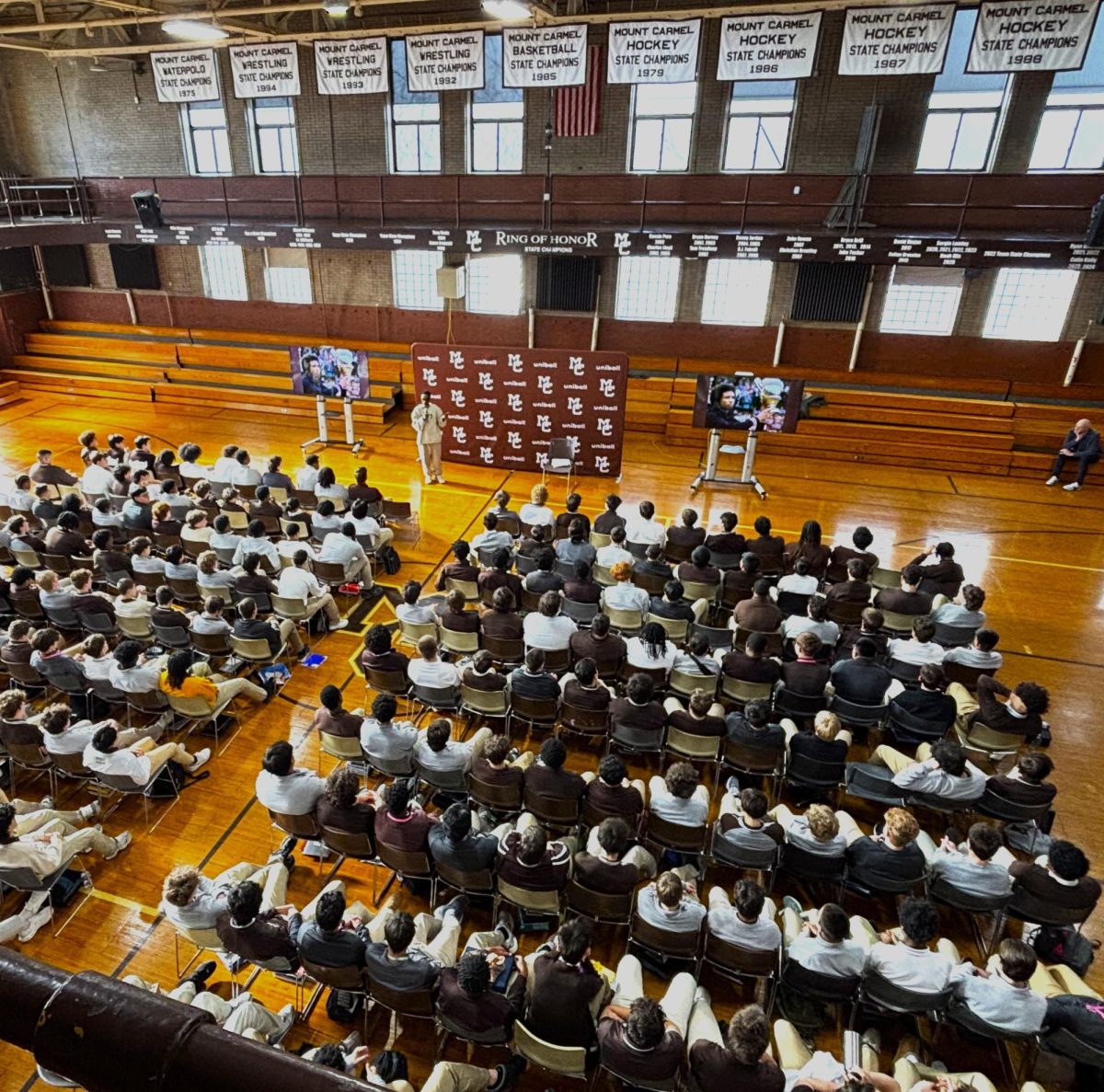
How do sports, civil rights, and leadership connect in today’s world? That was the question to students during Mount Carmel’s Dr. Martin Luther King Jr. assembly when sports journalist Mr. Scoop Jackson spoke about sports and how they were able to change civil rights. The assembly, held in honor of the Dr. King holiday, focused on the role sports have played in the civil rights movement.
Mr. Jackson, a Chicago-based sports journalist and author, was invited to speak to MC students on Tuesday, January 20, and Thursday, January 22. Rather than delivering a historical lecture about what Dr. King did in his pursuit of civil rights, Mr. Jackson connected King’s legacy to modern sports, explaining how athletics have served as a gateway for progress to equality. The event was organized by Mr. Dan LaCount of the Counseling Department, who helped coordinate the speaker and the theme.
“There wasn’t a speaker schedule, but I knew Scoop lived in the neighborhood and had written a really strong article about Mount Carmel’s football program,” Mr. LaCount said when explaining why Mr. Jackson was invited. “I thought he was someone who could relate to our students.”
Mr. LaCount said the goal of the assembly was not simply to review Dr. King’s life, but to make the message meaningful for students today.
“Athletics are a big part of who we are at Mount Carmel, and a lot of kids can relate to that.” Mr. LaCount said. “I wanted a speaker who could talk about civil rights today and connect it to athletes.”
Mr. Jackson’s message centred on how sports have a big picture, and how the civil rights struggle has changed since the 1960s. While opportunities have increased for people of color, Mr. Jackson argued that real power, like ownership and executive leadership, still remains limited for people of color.
“We have to be prepared for the backlash that we did not have back then,” Mr. Jackson said.
He talks about the differences between past and present struggles for equality. Discussing how social change is often accompanied by resistance. His remarks challenged students to consider how progress is measured.
“Sports are not just sports,” Mr. Jackson said. “It is a business.”
The assembly explored how leadership roles extend beyond the playing field. Students were encouraged to think about who holds decision-making power in major businesses.
Students said the assembly helped them see sports differently. Students referenced the use of sports examples throughout the presentation.
“I really learned how Martin Luther King was really influenced by the history of black people involving themselves in sports,” junior Jeremy Ingram said. “He really emphasized how sports bring togetherness.”
Ingram also mentioned moments when the speaker referenced Chicago teams. Those examples were used to connect the topic to the city’s shared experiences.
“He really emphasized how Chicago felt unified,” Ingram said, referring to when Mr. Jackson was talking about the Bears’ recent playoff run.
Junior Aaron Hyler said the presentation increased awareness of leadership and representation.
“He made me more aware of the need for more black participation in ownership, in power, roles, and seats at the table,” said Hyler.
He also pointed to how sports were framed as part of a larger historical movement.
“Sports could be seen as entertainment, but it led on to the civil rights movement,” Hyler said.
The assembly concluded with a final message from the speaker.
“I want you all to look at sports as the power it actually has to make those types of changes,” Mr. Jackson said.