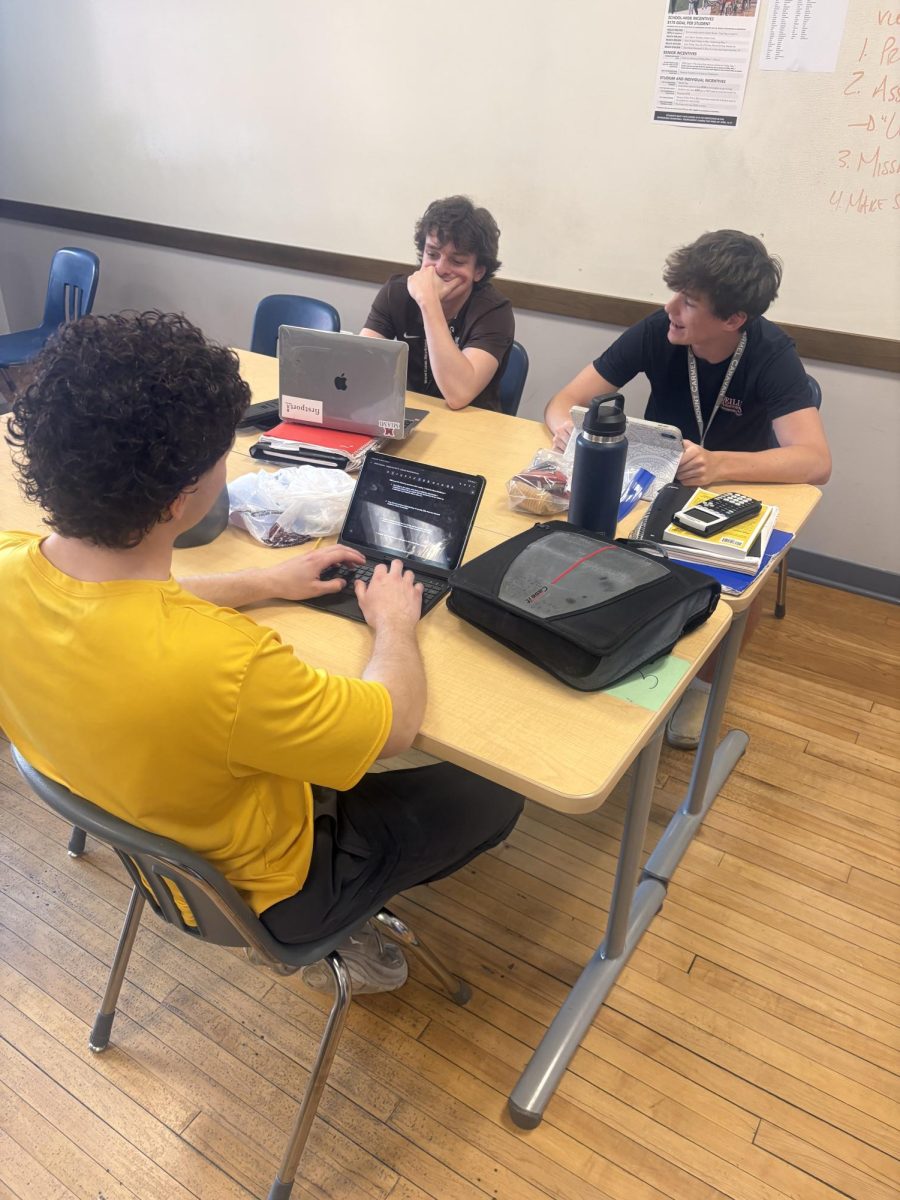


AI is a convenient tool, but sometimes things can be too good to be true. With AI becoming the new Google, many people are incorporating it into their day-to-day lives, including students and teachers at Mount Carmel.
Large language models, or LLMs, like ChatGPT are easy-to-use tools that quickly give mostly correct answers and increase efficiency for difficult tasks. But these benefits come at a cost, with AI causing major problems for the environment, critical thinking skills, and people beginning to depend on it.
In some cases, people may not even be aware of the damage AI causes. According to the Massachusetts Institute of Technology, “The computational power required to train generative AI models that often have billions of parameters, such as OpenAI’s GPT-4, can demand a staggering amount of electricity, which leads to increased carbon dioxide emissions and pressures on the electric grid. . . . Beyond electricity demands, a great deal of water is needed to cool the hardware used for training, deploying, and fine-tuning generative AI models, which can strain municipal water supplies and disrupt local ecosystems.”
Some MC students do know of such impacts. “I probably will stop using it if it’s causing that bad of an environmental change in the world we live in,” said MC junior Jaime Carrasco.
With the damage AI causes to the environment, it’s important to have it in mind when using it.
“The main caveat that I think I have an issue with using it is that how much energy it takes from the environment,” said Mr. Brooks Nevrly, an English teacher at MC. “I think that that’s one of the things that I’m always weary of, is how much the servers and everything impacts the environment.”
As AI becomes more and more normalized, understanding the impact AI has on the environment is crucial to keep in mind when using it.
“When I learned about the environmental impact of AI, I started to use it even less,” said 2025 MC grad Ulysses Zavala. “But now this year, I rarely use it just because I understand that it is very bad for the environment.”
Understanding that AI is harming the environment and learning to let it go may be difficult for some, but it is necessary. Not only is it bad for the world, but it is also bad for the mind, as people are beginning to lose critical thinking skills because of their use of AI.
“I feel like instead of them taking the time, they’re relying more on AI to think for them so they don’t have to do anything,” said Carrasco, “I just feel like it makes them feel like they could just go to AI instead of having to do the hard work.”
Those who often use LLMs may begin to rely on them to do their thinking for them. It is quick and easy to put a difficult question or assignment into an LLM and instantly get an answer, rather than having to think on one’s own.
“AI is a great tool to aid students in critical thinking,” said Mr. Nevrly, “But kids don’t use it in the way that would develop those skills purely because they use it to get to the means to an end. They don’t use it for the process.”
LLMs used in the right way can develop skills instead of taking them away. But many would rather just get the answer instead of getting the way to the answer.
“People just get lazy, and they see AI’s like, almost like the new Photomath,” said Zavala, referring to an online tool that allows students to upload pictures of math problems to be instantly solve. “When they feel like not doing their homework, they just plug it into ChatGPT, and that’s kind of affecting their critical thinking skills. [Using AI] doesn’t really force them to really think deeply.”
LLMs should not be used as a way to get the answer and simply copy and paste what it says. It should be used in a way that helps the user understand the problem and helps solve it.
AI is something that should be used only when it is really needed, it is not something that should be depended on.
“Last reserve,” said Carrasco. “I’m at home and I have no one to ask the question to, I’ll use it. I could always figure it out by myself or email a teacher if I need to.”
Mr. Nevrly considered justifiable reasons for using AI.
“The only thing I can think of is when I was in France this summer. And I used AI to like speak French to people,” said Mr. Nevrly, “Without it, I would have been clueless.”
So, yes, AI can be used in ways that are useful outside of the classroom. Having an issue regarding a language barrier is a situation where an AI tool can be useful.
“I only use AI when it’s like a last resort, I guess. So I rarely use AI,” Zavala said, “Only if I’m really, really stuck on a problem.”
In a situation where a person may be able to use AI, it is not necessarily a bad thing. The way one chooses to use it determines that.
Using LLMs should be limited to a last resort situation to guide the user in the right direction, whether it is homework or a language barrier, the first thing that comes to mind to solve issues should not be AI.
Being able to use a technology like AI is fantastic, it just depends on the way the user makes use of it. With all the issues AI brings, it should be used as a last resort aid, not the first thing that comes to mind in a situation where somebody needs help.