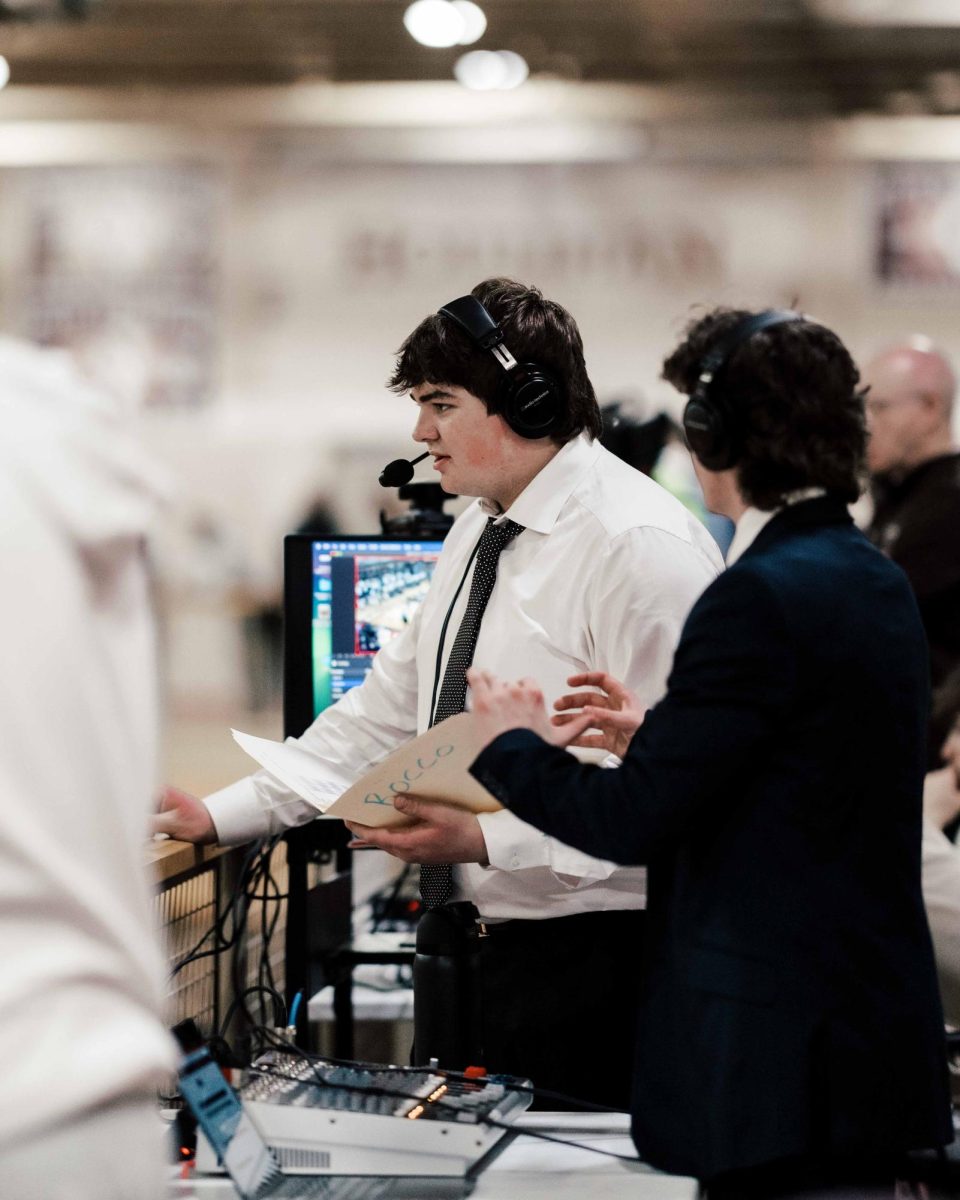

Every morning at 8:05, Mount Carmel High School students hear announcements over the PA system. While it provides information, it often struggles to hold students’ attention. During the 2024-25 school year, when the PA system was under repair last spring, announcements were temporarily replaced with student-produced video announcements until the end of the school year. That change revealed a new possibility for sharing school news, one that deserves more consideration.
A broadcast news station at MC would provide information on community events, sports updates, weather, and student messages. This would be produced weekly and pre-recorded, and the video would be shared through the Caravan Broadcast Network on YouTube. This will give students time to plan and edit content without needing to come to school early in the morning to film the news live. Rather than replacing the announcements live, the videos would be posted online and can be watched by students, teachers, and alumni outside the school day.
Students have expressed since last school year that video announcements are more engaging than the PA system.
Many students admit that they often tune out the PA unless the announcement directly affects them. While the broadcast would not replace live announcements, students who are involved in clubs, athletics, or upcoming events would be more likely to seek out the video for information that directly affects them. Teachers could also choose to replay the broadcast during class periods, or in studium letting students who might not seek it out on their own still see the content.
“I liked it a lot,” says sophomore James Weber, referring to the video broadcast. “I thought it was better than the morning announcements [over the PA].”
When announcements are visual and student-produced, they feel less like background noise and more like content worth watching. Other students also pointed to the quality of the broadcast as a factor.
“The video part was very nice, and I think the media team did a really good job with that last year,” says junior Aaron Hyler, who also expressed interest in being an anchor on a potential MC news broadcast.
Consistent quality matters when building trust in a source of information. If school news feels intentional and well-produced, students are more likely to take it seriously. Having a video would make school communication more effective by matching how students actually engage with media through sites like TikTok and Instagram.
A student-run news station can expand communication beyond the school day. Traditional PA announcements only reach students who are present and paying attention in that moment. Having the ability to put it on YouTube lets people outside of school see it beyond a single time and place, giving viewers flexibility in how and when they engage with school news.
“Sometimes parents watched it, sometimes teachers replayed it,” says MC media moderator Ms. Eleanore Menke.
In addition to families, broadcasting also strengthens long-term community connections. Alumni often lose regular access to school life after graduation, but digital media creates an opportunity to maintain that connection in a meaningful way.
“You just never know who’s watching,” says Ms. Menke. “All of a sudden, you’ve got somebody who hasn’t been here in years.”
By showing what is happening at MC, more students, families, and alumni can stay involved.
Creating and maintaining a student-run news station requires students to take responsibility.
Broadcasting demands consistency, preparation, and teamwork. Each role depends on others, meaning that students must plan and problem-solve when challenges arise. This environment encourages accountability rather than passive participation.
“If [a student on last year’s production team] knew like, ‘Hey, I’m going to be out tomorrow,’ they had to find a substitute, and they had to teach them,” Ms. Menke says.
A news station also creates opportunities for leadership and collaboration. With multiple positions involved, students must communicate clearly, delegate tasks, and respect shared goals.
The media at MC is mostly all students, with guidance from Ms. Menke. The news station would give students further experience that they need if they want to work in media.
What began as a temporary response to a technical issue revealed a different way school communication could function. Students’ voices reached beyond the classroom, information became accessible outside the school day, and collaboration turned into a shared responsibility.
The groundwork exists. What remains is deciding whether that moment was a one-time exception or the starting point of something lasting.