
During one of the most watched nights across America, Spanish lyrics filled the ears of many across the country.
On February 8, 2026, Benito Antonio Martínez Ocasio, more commonly known as Bad Bunny, didn’t just perform at the Super Bowl but put Latino pride on the biggest stage. Not only was it a win for Latin American representation, but it also sent a strong message that Hispanic members of the Mount Carmel community appreciate.
Mr. Victor Guaramato, an MC Spanish teacher born and raised in Venezuela, admitted he was not originally a fan of Bad Bunny’s music, but after watching the halftime performance his reaction changed. Mr. Guaramato admitted it was bigger than the music for him.
“I understood that message was being sent,” he says. “He showed this is what we are. This is what we do. And we are not really what some people have been trying to show the world that we are.”
Bad Bunny not only wanted to bring attention to his birthplace of Puerto Rico, but also to the entire Latino community, giving the people a voice and something to be prideful about. Leaving a message that love is stronger than hate was the cherry on top, and something that everyone should be open to, especially the MC community.
Counselor Mrs. Vanessa Miguez, a Peruvian American, described her reaction as more personal and emotional. “For me, it was really nostalgic,” she says. She explained that the performance “just reminded me of, like, growing up. I felt really happy, I mean I was having a blast.”
Johan Miyares, an MC junior and Cuban American, spoke of the impact it had on his family. “It really excited them to see a Latino make a huge impact in an American-dominated scene.” He went on to say how the performance was also pretty cool for him to see another Latino on the big stage, making him feel proud of being Latino.
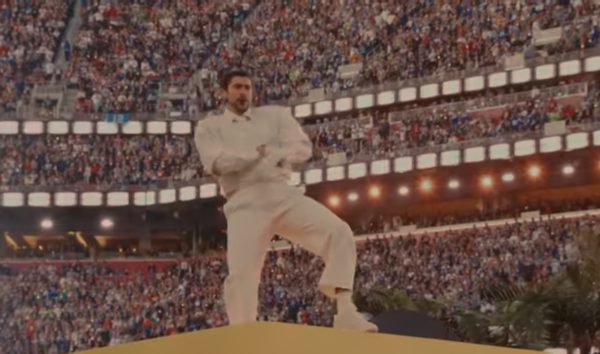
With the vibes high during the halftime show, this was more than a performance. It felt like a spotlight on the culture giving them the right light. But the performance was not well received by everyone.
Mr. Guaramato noticed reactions during the next school day. Prior to the performance and even after the performance there was a lot of criticism towards Bad Bunny being chosen to perform, since his songs are almost entirely in Spanish. Mr. Guaramato says, “I heard a lot of kids complaining about the speaking in the whole time show, just repeating what they hear.” He explained that “they really don’t understand what is going on.”
Many didn’t understand the true meaning behind it and instead took it simply as a non-English performance at the halftime show.
Mrs. Miguez also heard the criticism. She says, “I really wished that it would have been just as easy as the way I celebrate other cultures.” She pointed out, “It’s 15 minutes. It shouldn’t have been that big of a deal.”
She went on saying how Mount Carmel does a good job of celebrating lots of cultures and just wished critics felt the same with what Bad Bunny was doing.
Haiden Lajcin, an MC senior and Puerto Rican and Cuban American, described having to defend the performance while watching it with a person who was making negative remarks. “I was just trying to let him know, you’re disrespecting him and in a way disrespecting me.” He added, “It means a lot what he’s doing for our culture. It really is inspiring.”
Lajcin went on to say how the Hispanic culture is very loving and about unity, which Mrs. Miguez echoed. Hispanic cultures are strong and very prideful, so when people come at the culture, members of it just want those people to have a better understanding of what is going on.
Bad Bunny’s closing message was “The only thing more powerful than hate is love,” which read in large letters on the stadium big screen during the performance. Such a message connects directly to the MC community. When a community is filled with more hate than love, it will always fail. MC does a great job with promoting love, but if everyone chooses love over hate the strength in the community will grow stronger and that brotherhood connection will be even tighter.
“Mount Carmel is first a Catholic school,” Mr. Guaramato notes. “So we preach the Gospel. Christ calls us to love each other.” He clarified that love is not only a word, stating, “It is not only a term or an abstract term that is related to a feeling, but actions as well.”
Lajcin was adamant about the respect between cultures. He added that for him in his Hispanic culture the Gospel is important, as is always trying to live how Jesus did. “If you look at Jesus, Jesus only showed love,” he points out. “We need to rely more on love than hate.”
This should be a reminder to students that love should always come first in any instance.
Miyares took this message in a different sense, comparing it to teamwork. “We are stronger as one if we were instead of fighting with each other,” he says. “If you have a team that can all work together, you guys can make something happen.”
There needs to be more love in the world, and the MC community can thrive even more if that approach is taken more seriously.
The halftime show sparked both conversation and pride. MC students and faculty described pride, understanding, and frustration with backlash. The hope for more of the first two.
The performance placed Latino culture on one of the world’s biggest stages and ended with a message of unity.